
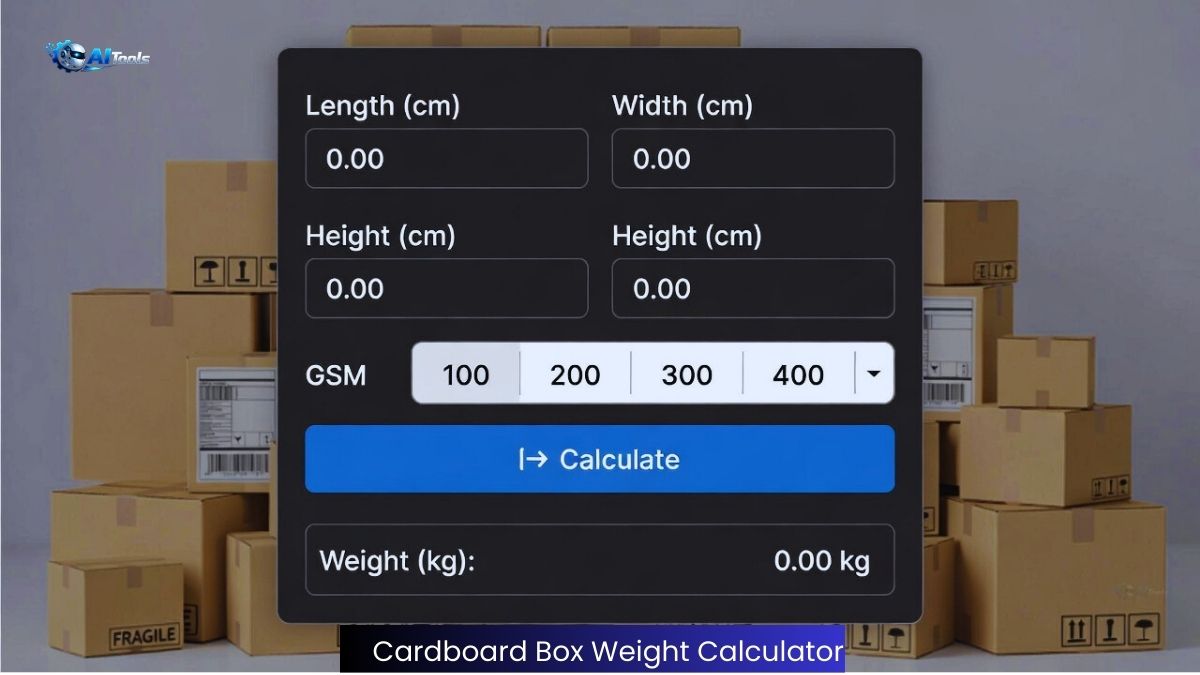
Cardboard Box Weight Calculator
Estimate the weight of a cardboard box from dimensions and material specifications. Professional tool for calculating weight of a cardboard box for packaging, shipping, and manufacturing needs.
About the Cardboard Box Weight Calculator: How, Why, Who, and Where to Use This Tool
The cardboard box weight calculator is a specialized tool designed to estimate the material weight of an empty cardboard box based on its dimensions and paper grammage (GSM). This weight of a cardboard box estimator is invaluable for professionals in packaging, shipping, manufacturing, and logistics who need accurate predictions without physical weighing.
How it works: Input the box’s length, width, height in centimeters, and the cardboard’s GSM (grams per square meter). The tool calculates the approximate surface area of the box material and multiplies by GSM to determine weight, convertible to grams, kilograms, pounds, or ounces. Why use it? Knowing the weight of a cardboard box helps optimize shipping costs, ensure structural integrity, comply with carrier regulations, and plan inventory efficiently.
Who uses it: Packaging designers, e-commerce sellers, manufacturers of goods like electronics or apparel, logistics managers, and even hobbyists crafting custom boxes. Where: In warehouses for load planning, design offices for prototype evaluation, online retail for cost estimation, or factories integrating with production lines. For example, when designing storage solutions, calculating weight of a cardboard box ensures safe stacking without collapse.
Steps for Working with the Calculator
1. Measure dimensions: Get accurate length, width, height in cm using a ruler or tape.
2. Determine GSM: Check cardboard specification — common values 200-500 GSM for boxes.
3. Input values: Enter dimensions and GSM into the tool.
4. Select unit: Choose preferred output (g, kg, lb, oz).
5. Calculate: Click button for instant result.
6. Interpret: Use weight for cost, shipping, or design decisions.
Cardboard Box Weight Formula
Weight (g) = Surface Area (m²) × GSM (g/m²)
Surface Area ≈ 2 × (L×W + L×H + W×H) / 10,000 (to m²)
Convert to other units as needed.
Formula Explanation
The formula estimates material used by calculating box surface area, assuming minimal waste. Multiply by GSM (paper density) for weight. Divide by 10,000 converts cm² to m². This approximation works well for standard boxes; complex designs may need adjustment for flaps/waste.
Example Calculation
For a 30x20x15 cm box with 300 GSM: Surface area = 2×(30×20 + 30×15 + 20×15) = 2,100 cm² = 0.21 m². Weight = 0.21 × 300 = 63 g (~0.14 lb).
Common Cardboard Box Weights
| Size (cm) | GSM | Weight (g approx) | Weight (lb) |
|---|---|---|---|
| 15x10x10 | 250 | 25 | 0.055 |
| 30x20x15 | 300 | 63 | 0.139 |
| 40x30x20 | 400 | 152 | 0.335 |
| 60x40x30 | 500 | 360 | 0.794 |
Frequently Asked Questions
How accurate is this weight of a cardboard box calculator?
Provides close estimates for standard boxes; actual may vary 5-15% due to manufacturing.
What is GSM in cardboard?
Grams per square meter — measures paper density. Higher GSM = thicker, heavier box.
Does the tool account for double-wall boxes?
Use average GSM for multi-layer; for precision, multiply layers.
Why calculate weight of a cardboard box?
For shipping costs, structural design, and inventory planning.
Can I use inches instead?
Convert to cm first (1 inch = 2.54 cm).
How to reduce box weight?
Use lower GSM or optimize dimensions for less material.