
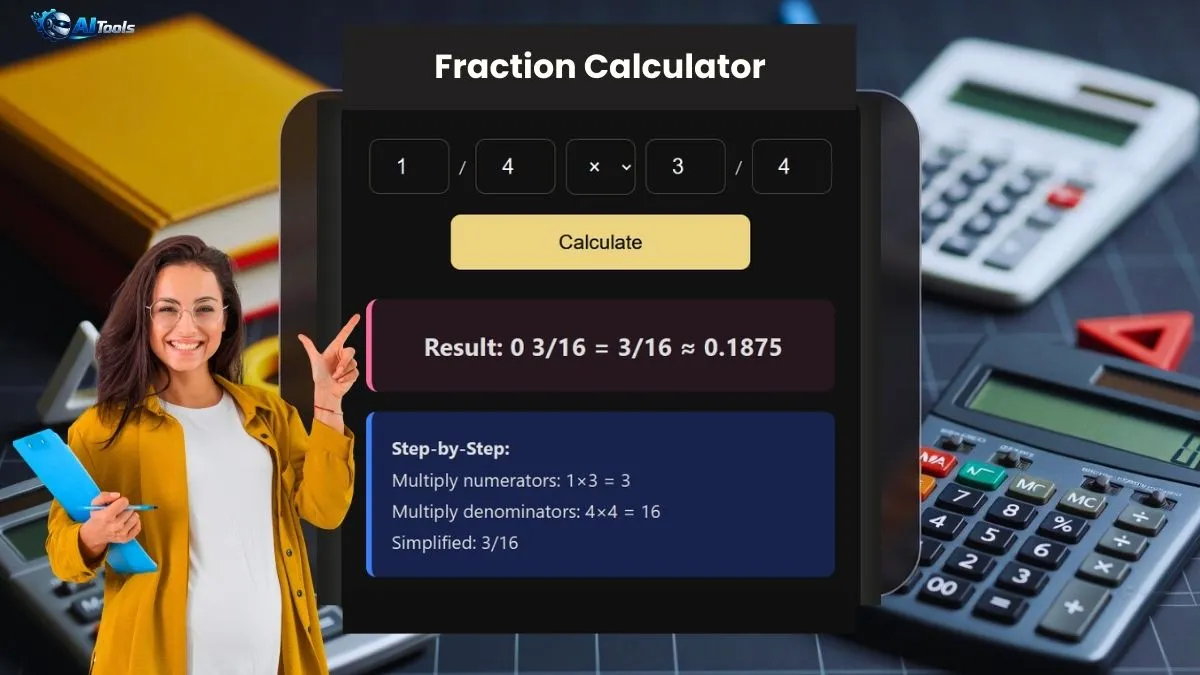
Fraction Calculator
Perform addition, subtraction, multiplication, and division of fractions. Simplify results, convert to mixed numbers, decimals. Ideal for math problems like 1 4 x 3 3 4. Professional online fraction calculator for students, cooks, engineers.
Contents
- What is a fraction? Fraction definition
- What is a proper, improper, and mixed fraction?
- How do you add fractions? ➕ Adding fractions rules
- How to subtract fractions ➖
- How do you multiply fractions? ✖️
- How to divide fractions ➗
- How to simplify fractions
- How to convert a decimal into fraction
- How to turn a fraction into a decimal
- FAQs
What is a Fraction? Fraction Definition
A fraction represents a part of a whole, consisting of a numerator (top number) and denominator (bottom number). The numerator indicates how many parts you have, while the denominator shows total parts in the whole. Fractions are fundamental in mathematics, used in everyday scenarios like cooking (e.g., 1/4 cup), measurements, and finances.
The fraction definition traces to ancient civilizations, but modern usage standardizes it as rational numbers. Proper fractions have numerator < denominator, improper have numerator ≥ denominator. Mixed fractions combine whole numbers with proper fractions (e.g., 1 1/4).
What is a Proper, Improper, and Mixed Fraction?
A proper fraction has numerator less than denominator (e.g., 3/4 = 0.75). An improper fraction has numerator greater than or equal to denominator (e.g., 5/4 = 1.25). Mixed fractions combine whole numbers with proper fractions (e.g., 1 1/4).
Converting between them is key for operations. This tool automatically simplifies and converts results to mixed format when appropriate.
How Do You Add Fractions? ➕ Adding Fractions Rules
To add fractions, find a common denominator (LCM of denominators), convert each to equivalent fractions, add numerators, and simplify. For different denominators: (a/b + c/d) = (a*d + c*b) / (b*d).
Rules: Same denominator — add numerators directly. Mixed numbers — convert to improper first. This calculator shows steps for clarity.
How to Subtract Fractions ➖
Similar to addition: Common denominator, subtract numerators: (a/b – c/d) = (a*d – c*b) / (b*d). Borrow from whole numbers in mixed fractions if needed. Essential for recipes or woodworking measurements.
How Do You Multiply Fractions? ✖️
Multiply numerators and denominators: (a/b × c/d) = (a*c) / (b*d). Simplify before or after. Example: 1 4 x 3 3 4 = (5/4) × (15/4) = 75/16 = 4 11/16. Great for scaling recipes.
How to Divide Fractions ➗
Multiply by reciprocal: (a/b ÷ c/d) = (a/b × d/c) = (a*d) / (b*c). Flip the second fraction and multiply. Useful in ratio problems.
How to Simplify Fractions
Divide numerator and denominator by GCD. Example: 75/100 ÷ 25 = 3/4. Reduces fractions to lowest terms for clarity.
How to Convert a Decimal into Fraction
Write decimal as fraction over power of 10, simplify. Example: 0.75 = 75/100 = 3/4. Repeating decimals use algebraic methods.
How to Turn a Fraction into a Decimal
Divide numerator by denominator. Example: 3/4 = 0.75. Infinite for non-terminating like 1/3 = 0.333…
Frequently Asked Questions- Fraction Calculator
What is 1 4 x 3 3 4?
Convert to improper: 1/4 × 15/4 = 15/16 ≈ 0.9375.
How to add mixed fractions?
Convert to improper, add, convert back.
What’s an equivalent fraction?
Same value, different numbers (e.g., 1/2 = 2/4).
Can fractions be negative?
Yes — numerator or denominator negative (e.g., -3/4).
How to compare fractions?
Common denominator or cross-multiply.
What’s a unit fraction?
Numerator 1 (e.g., 1/5).