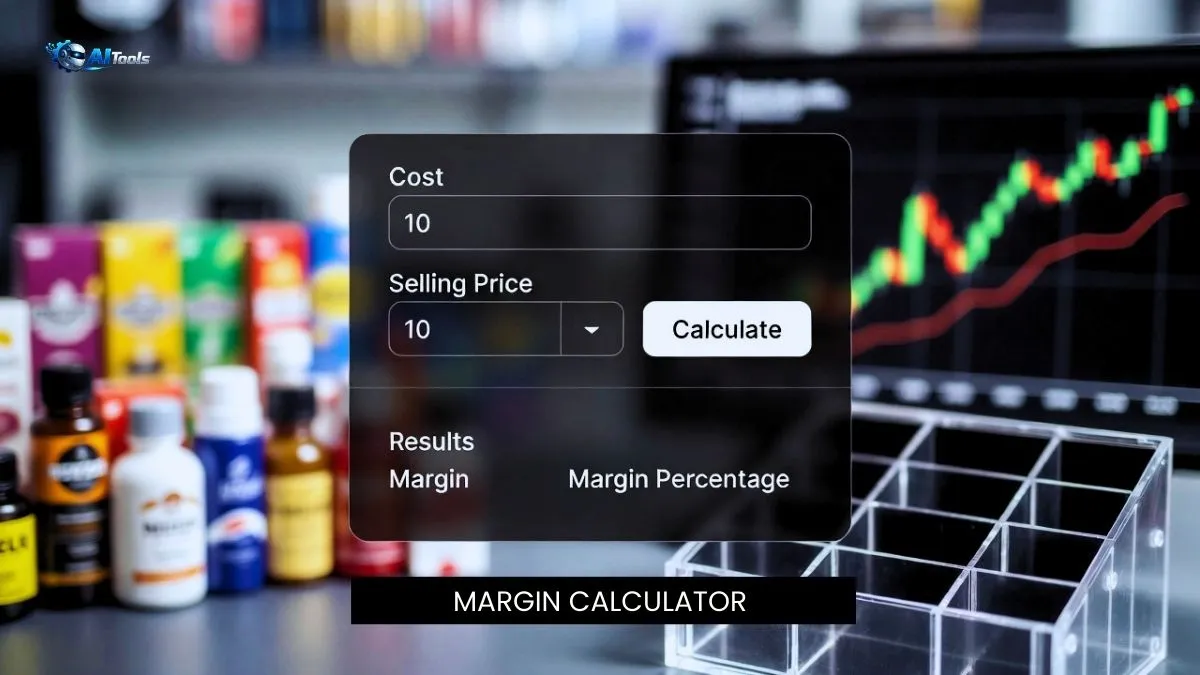
Margin Calculator
Calculate profit margin percentage, gross margin from cost and selling price. Professional gross margin calculator for business analysis, pricing strategy, and financial planning. Includes 12 cell box divider examples for retail inventory.
About the Margin Calculator: How, Why, Who, and Where to Use This Tool
The margin calculator is a fundamental business tool that helps determine the profitability of products or services by calculating the profit margin percentage from cost and selling price. This gross margin calculator uses the simple formula: Margin % = ((Selling Price – Cost Price) / Selling Price) × 100. It’s essential for pricing strategies, financial analysis, and ensuring sustainable profits.
How to use: Input your cost price (production or acquisition cost) and selling price (revenue per unit). The tool instantly computes the margin percentage and absolute profit. Why use it? Accurate margins help avoid underpricing, maximize revenue, and inform decisions like discounting or bulk purchasing. For example, in retail, knowing margins on items like a 12 cell box divider (a popular storage organizer) ensures competitive pricing while maintaining profitability.
Who uses it: Business owners, e-commerce sellers, retailers, manufacturers, accountants, and financial analysts. Where: In daily operations for product pricing, quarterly reviews for performance metrics, or strategic planning for expansion. This profit margin calculator is indispensable in industries like retail, where thin margins on high-volume items like 12 cell box dividers require precise calculations.
How to Calculate Profit Margin
Profit margin calculation starts with two key numbers: cost of goods sold (COGS) and revenue. Subtract COGS from revenue to get gross profit, then divide by revenue and multiply by 100 for percentage. For single products, it’s (Selling Price – Cost) / Selling Price × 100.
Step-by-step: 1) Determine total cost including materials, labor, overhead. 2) Set selling price based on market. 3) Compute difference as profit. 4) Divide profit by selling price. Example: A 12 cell box divider costs $8 to produce and sells for $15 — margin = ($15 – $8) / $15 × 100 = 46.67%.
Gross Margin Formula
The gross margin formula is: Gross Margin % = (Revenue – COGS) / Revenue × 100. It focuses on direct costs, ignoring operating expenses. This makes it ideal for product-level analysis. For businesses selling physical goods like 12 cell box dividers, high gross margins (50%+) indicate strong pricing power.
Net margin subtracts all expenses, but gross margin highlights core profitability. Use this gross margin calculator to test scenarios — e.g., if costs rise 10% on box dividers, how does margin change?
A Note on Terminology
“Margin” typically means profit margin percentage, while “markup” is the percentage added to cost. Don’t confuse them — a 50% markup (selling at 1.5x cost) yields 33.3% margin. This tool focuses on margin, the key metric for financial health.
In retail contexts, like selling 12 cell box dividers, understanding terminology prevents miscalculations that could erode profits.
Margin vs. Markup
Margin is profit relative to selling price; markup is profit relative to cost. Formula: Markup % = (Selling Price – Cost) / Cost × 100. A common error is using them interchangeably. For a $10 cost item at $15: Markup 50%, Margin 33.3%.
Businesses use markup for pricing, margin for profitability analysis. In inventory-heavy sectors like storage solutions (e.g., 12 cell box dividers), correct distinction ensures accurate financial reporting.
Frequently Asked Questions
What is a good profit margin?
Depends on industry — retail 5–10%, tech 20–30%. For low-cost items like 12 cell box dividers, aim for 40–60%.
How to improve gross margin?
Reduce costs, raise prices, or optimize mix. Bulk purchasing 12 cell box dividers can lower per-unit cost.
What’s the difference between gross and net margin?
Gross ignores operating expenses; net includes all costs.
Can margin be negative?
Yes — indicates loss. Critical to identify for products like low-margin 12 cell box dividers.
How does markup relate to margin?
Markup = Margin / (1 – Margin). 50% margin = 100% markup.
Why use a margin calculator?
For quick, error-free calculations in business planning and pricing.